
$47,000. That Was Everything in the Bank. What That Monday Morning Taught Me About Running a Business.
Jul 15, 2026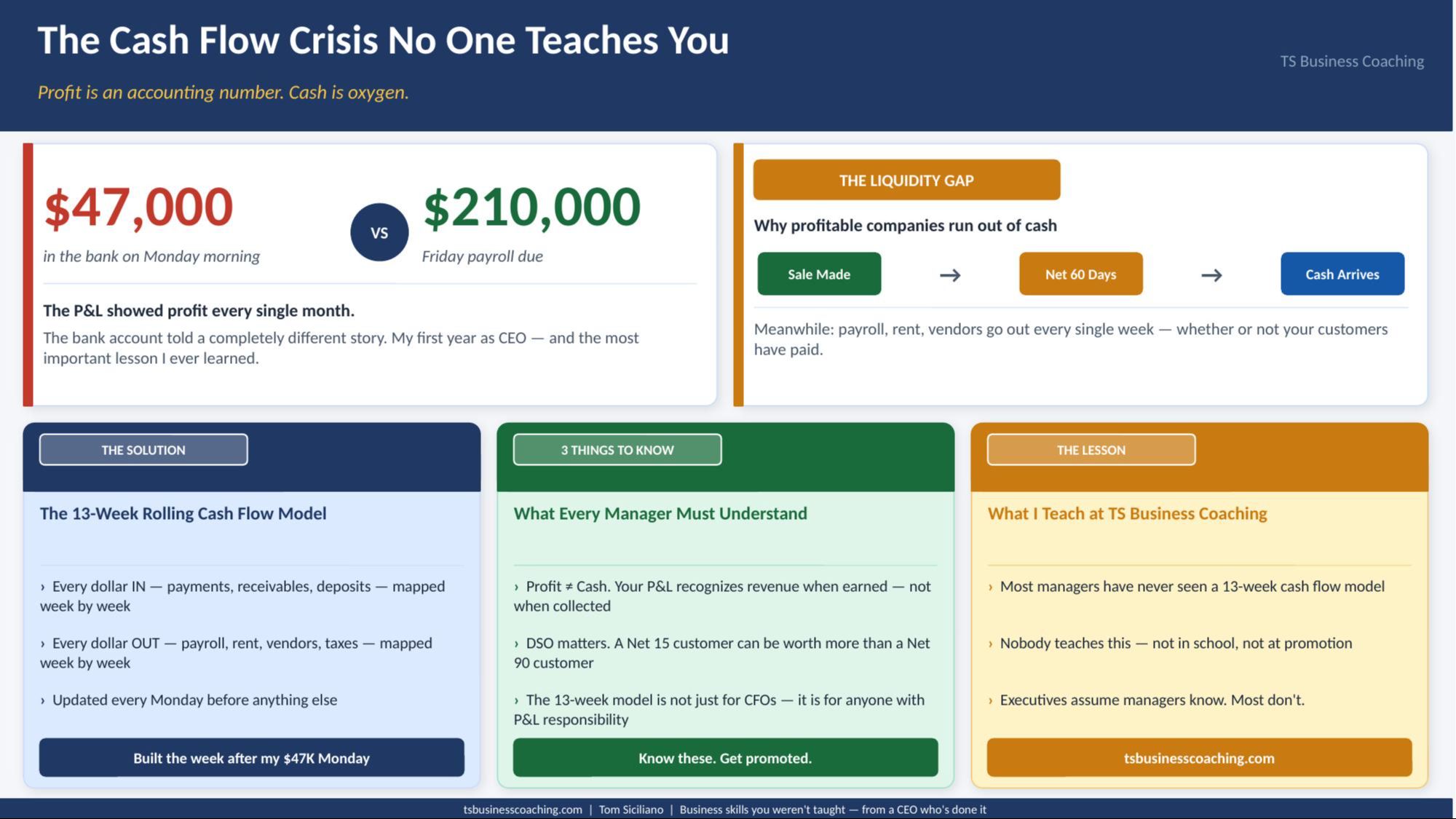
$47,000. That Was Everything in the Bank.
What That Monday Morning Taught Me About Running a Business.
By Tom Siciliano | Former CEO & President | Founder, TS Business Coaching
I will never forget that Monday morning.
I walked into the office, sat down at my desk, and my controller knocked on the door and closed it behind him.
That is never a good sign.
"Tom, we have a problem."
He pulled up the bank balance. $47,000.
Friday payroll was $210,000.
The P&L showed we were profitable. Every single month. Green across the board.
The bank account told a completely different story.
That was my first year as CEO. And it was the day I learned one of the most important lessons of my career, a lesson that no one had ever taught me, and one that I now teach to every manager and leader I work with.
Profit is an accounting number. Cash is oxygen.
The Gap Nobody Talks About
Here is what most managers do not understand and what most executives assume everyone already knows.
A company can be profitable on paper and completely out of cash at the same time.
How? Because profit and cash are not the same thing.
Your P&L shows revenue when a sale is made. Not when the customer pays. If you sell $500,000 in January but your customers pay on Net 60 terms, that cash does not arrive until March. Meanwhile your payroll, rent, vendor payments, and overhead go out every single week.
That gap between when revenue is recognized and when cash actually arrives is called the liquidity gap. And it has killed profitable companies throughout history.
I was running a profitable company. On paper I was doing everything right. But I had not been watching the timing of cash in versus cash out. And on a Monday morning in my first year as CEO, that gap nearly brought everything down.
We made payroll that Friday. But just barely.
I never let it happen again.
What I Built the Following Week
The Monday after that Friday, my controller and I sat down and built something I should have had from day one.
A 13-week rolling cash flow model.
It sounds more complicated than it is. Here is what it does:
- Every dollar coming in customer payments, receivables, deposits, mapped out week by week for the next 13 weeks.
- Every dollar going out payroll, rent, vendor payments, debt service, taxes mapped out week by week for the next 13 weeks.
- Updated every Monday morning before I looked at anything else.
That model gave me something no P&L ever could. It gave me visibility. I could see a cash shortfall coming three, four, five weeks before it arrived. That meant I had time to act accelerate collections, delay a payment, draw on a credit line, make a decision instead of walking into a Friday with $47,000 in the bank and $210,000 going out the door.
That model changed how I ran every company after that. And I have never gone without one since.
Why Most Managers Have Never Heard of This
Over my 30-year career leading companies across multiple industries, I have worked with hundreds of managers and directors. Many of them were talented, driven, and hardworking.
Most of them had never seen a 13-week rolling cash flow model.
Many had never built one.
Some had never even heard of one.
That is not a criticism. It is an observation about how business education actually works — or does not work.
Nobody teaches this. Not in school. Not when you get promoted. Not when you take on your first P&L. Executives assume their managers understand cash flow because they understand revenue. But those are two completely different things.
Revenue tells you how much business you did. Cash flow tells you whether you can keep doing it.
A manager who only watches the P&L is flying half-blind. A manager who understands both who can walk into a leadership meeting and speak to cash position, DSO, and liquidity is someone executives notice. Someone who gets promoted.
The Three Things Every Manager Should Understand About Cash Flow
You do not need to be a CFO to understand cash flow. But you do need to understand these three things.
- Profit and cash are not the same.
Your P&L is an accounting document. It recognizes revenue when it is earned, not when it is collected. It records expenses when they are incurred, not when they are paid. This means a profitable P&L can coexist with an empty bank account. Always ask: when does the cash actually arrive?
- DSO: Days Sales Outstanding, matters.
DSO measures the average number of days it takes your company to collect payment after a sale is made. A customer on Net 30 terms is very different from a customer on Net 90 terms. A smaller customer who pays in 15 days can be more valuable to your company's cash position than a larger customer paying in 90. Understand this and you think differently about every deal you negotiate.
- The 13-week model is not just for CFOs.
Any manager with P&L responsibility should be able to read a rolling cash flow model. If you run a team, manage a budget, or influence revenue and expenses in any way, understanding where cash is coming from and where it is going is part of your job. It is not optional. It is the difference between managing a budget and understanding a business.
What I Teach at TS Business Coaching
The cash flow experience I had in my first year as CEO is one of the reasons I built TS Business Coaching.
I was a strong performer. I had driven results for years. But there were gaps in my business knowledge that nobody had ever addressed gaps that nearly cost me everything on a Monday morning with a $47,000 bank balance and a $210,000 payroll due on Friday.
The Financial Mastery module inside TS Business Coaching covers exactly this. Not theory. Not textbook definitions.
Real frameworks. Real tools. The kind of financial literacy that lets you walk into any room any meeting with any executive and hold your own.
Because the managers who understand cash flow are not just better at their jobs.
They are the ones who get promoted.
Tom Siciliano is a former CEO and President who has led companies with P&L responsibility over $150M and teams of 1,100 people. He is the founder of TS Business Coaching, an online coaching and education platform teaching business fundamentals to managers, directors, and early VPs.
tsbusinesscoaching.com
These are the frameworks I built from 30 years leading companies. If any of this resonated and you want to go deeper, start with the free guide below. And if you want to talk about where you are in your career or what your team needs, Book a Free 15-minute call. No pitch. Just a conversation.